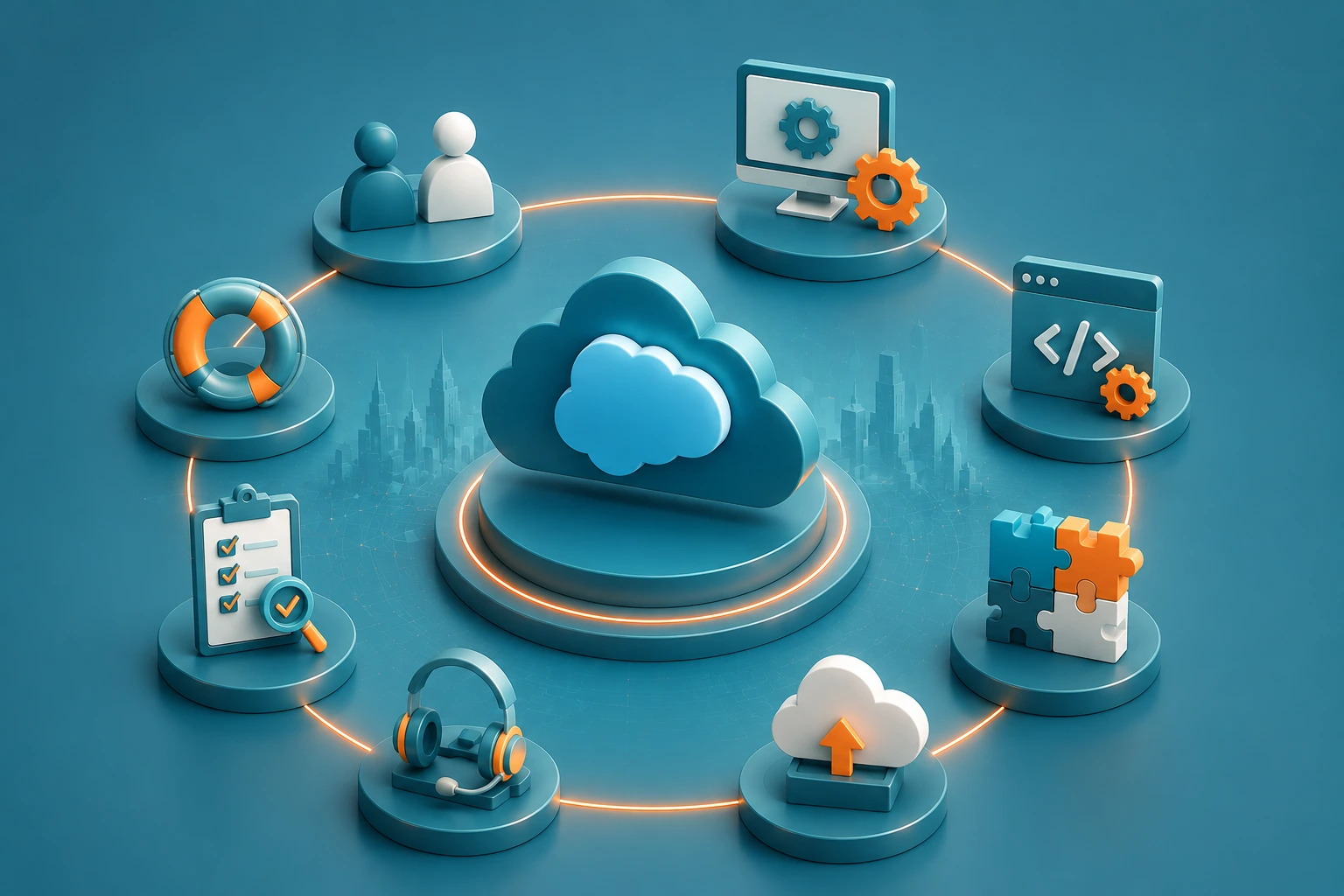
Salesforce integration connects Salesforce with other applications, platforms, databases, and business systems so that information and processes can work together.
Most organizations use multiple technology platforms. Salesforce may need to exchange data with ERP systems, websites, payment platforms, marketing systems, data warehouses, applications, and internal tools.
A well-designed integration can reduce manual data entry, improve data consistency, and create connected business processes.
Consider a business where a customer submits information through a website.
Without integration, an employee may need to manually enter the information into Salesforce.
With integration:
Website → API → Salesforce → Automation → Business Process
The information can move between systems automatically.
Salesforce provides multiple APIs and integration capabilities for different requirements. Salesforce’s own API guidance distinguishes REST, SOAP, Bulk, Metadata, GraphQL, Pub/Sub and other APIs according to use case and communication model.
REST API is commonly used for modern web and application integrations and supports JSON and XML.
SOAP API provides a structured web-service interface and can be useful for systems that rely on SOAP and WSDL-based integrations.
Bulk APIs are designed for processing large volumes of records asynchronously.
Metadata APIs can be used when managing and deploying Salesforce configuration and metadata.
Event-driven approaches can help systems respond to changes without relying exclusively on synchronous request-and-response integrations.
A typical architecture might look like:
Salesforce ↔ Integration Layer ↔ External Systems
The integration layer may contain middleware such as MuleSoft or custom integration services.
For simpler use cases, Salesforce may connect directly with an external API.
Security should be considered from the beginning of an integration project.
Important areas include:
Shrum Tech can help connect Salesforce with:
A scalable integration should have clearly defined ownership, authentication, error handling, logging, retry mechanisms, monitoring, and data mapping.
It is also important to determine which system is the source of truth for each type of information.
Common challenges include duplicate records, inconsistent data, API limits, authentication problems, failed transactions, incorrect mappings, integration downtime, and poor error handling.
Good integration architecture addresses these issues before they become production problems.
Shrum Tech provides Salesforce Integration Services covering API integration, middleware, external applications, data synchronization, authentication, custom Apex integrations, and integration monitoring.
We focus on building integrations that are secure, maintainable, and aligned with the organization’s long-term architecture.
Salesforce integration connects Salesforce with external applications and systems so they can exchange information and support connected business processes.
The appropriate API depends on data volume, architecture, real-time requirements, external system capabilities, and the type of operation required.
Yes. Salesforce can integrate with AWS using APIs, middleware, event-based architecture, and other integration approaches.
It can be secure when appropriate authentication, authorization, permissions, encryption, monitoring, and integration architecture are implemented.
Shrum Tech can help design and implement integrations between Salesforce and your business systems.